Teen Patti Master and India’s Three-Card Table Culture
Teen Patti Master is easiest to understand by starting with the Indian card game behind its name. Teen Patti combines a small hand of cards with decisions made before every hand is visible. The attraction is not an elaborate board or a long rulebook: a short round can contain hesitation, confidence and a sudden change of direction. Moving that experience onto a phone preserves the three-card idea, but it makes clear rules more important than familiar conversation.
For readers who know the game through family conversations, festival gatherings or friends, the language can feel immediately recognisable. That familiarity is useful, but it should not be mistaken for knowledge of every digital table. A remembered house rule, a joke about someone’s expression and an app’s written instructions belong to different kinds of information.
The name refers to a three-card game with a long-established place in Indian card-playing culture. Pagat’s Teen Patti rules describe the standard deck, the opening contribution and the distinction between playing without looking and playing after seeing one’s cards. Those mechanics help explain why the game supports so much conversation: the table sees actions, while much of the information behind them remains private.
Picture an ordinary social situation, rather than a report of a particular gathering. Someone pauses before continuing. Another person makes a confident remark. A third chooses to leave the round. The conversation supplies a story about those decisions, but the story may be wrong. A quiet player does not necessarily have a weak hand, and an amusing prediction does not change the cards.
This separation is part of what makes three-card play interesting to people who enjoy language and observation. There is room for humour without treating humour as evidence. A memorable line can capture the mood of a table; it cannot establish another player’s hand or turn a risky decision into a reliable one.
What changes when the table becomes a screen
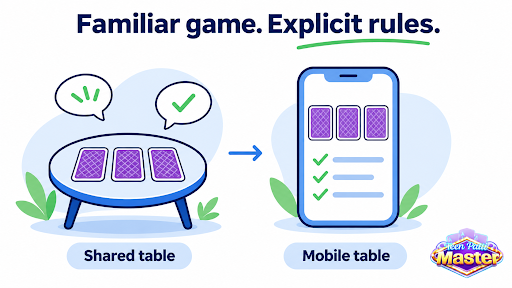
On a phone, a player cannot assume that everyone shares the same local convention. The interface must communicate what the table allows, what an action means and when the round has ended. Even a familiar term can need explanation when it appears beside an amount, a timer or a different game mode.
A useful comparison is a spoken agreement versus a written instruction. At a friendly physical table, someone can ask what a rule means before play begins. On mobile, the equivalent is checking the displayed rules and help information before committing to a round. Neither approach is inherently more trustworthy; the important point is that the rule should be understood rather than guessed.
The website for Teen Patti Master presents the brand as a mobile gaming environment centred on Teen Patti, with other card and casual games described in its lobby information. That gives a new reader a practical starting point: identify the intended game first, then look at its rules. A lobby is a collection of choices, not a guarantee that every choice uses the same mechanics.
Rummy, Ludo and Slots should therefore not be treated as alternative names for Teen Patti. Their objectives and decisions differ. Someone who arrives because they enjoy a three-card game should look for that specific format instead of assuming that recognition of the brand makes every available game familiar.
Three questions worth answering before a round
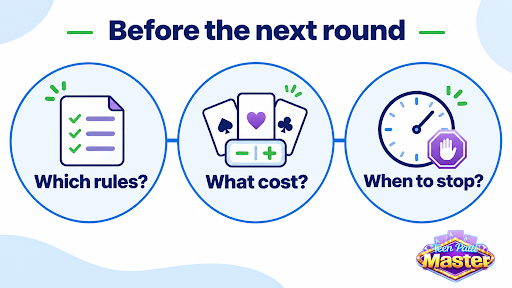
Before joining any table, answer three separate questions: which rules apply, what each decision can cost and when the session will end. These questions are more useful than asking whether the screen looks familiar. They turn general recognition into information that can actually guide a choice.
The first question concerns the game itself. Check the hand order, any special treatment of aces and whether a variation changes the usual deck or winning conditions. A player who knows one household version may still need to read another table’s instructions. A short clarification before play is better than discovering a disagreement only when two hands are compared.
The second question concerns commitment. An opening amount describes entry into a round, not necessarily everything a participant might later contribute. Keep the next action separate from the total already committed. If a screen does not make that distinction understandable, pause and seek an explanation rather than using a tap to find out.
The third question concerns attention and limits. Decide how long the session can reasonably last and, where eligible real-money play is involved, what loss limit is affordable. A new round does not become necessary because the previous one ended badly. It should remain possible to leave without needing a dramatic final hand to justify the evening.
Conversation can make play warmer, not more certain
A good social game leaves room for people to participate at different levels of confidence. Someone learning the terminology should be able to ask a basic question without being pushed into a decision. Explaining what a word means is helpful; insisting that a hesitant person continue because everyone else is playing is not.
The same distinction applies when friends exchange mobile-game links. Sharing a page about a game is not the same as vouching for somebody’s account, guaranteeing a reward or promising that a particular feature is available in every location. A recommendation is more useful when it identifies what the friend actually wanted to know.
For example, a reader looking into teen patti master online can use the brand homepage to distinguish its app information from its browser-play guidance. The word “online” describes access through a connection; it does not, by itself, establish that the browser and Android versions have identical features or account requirements. Follow the route that matches the intended device and task.
A familiar name still deserves a careful introduction
For an Indian reader encountering the brand for the first time, a useful introduction should separate three things: the traditional game, the particular product and the conditions attached to using it. The first supplies cultural familiarity. The second supplies practical information about access and available formats. The third determines whether and how an individual can participate.
This also explains why promotional language needs context. A free download describes the cost of obtaining software, not necessarily the cost of every activity inside it. A reward headline needs its own eligibility and usage conditions. Neither fact changes simply because the underlying card game is well known.
There is a useful way to explain the game to someone else without overwhelming them. Begin with the basic idea of three private cards and choices during a round. Then explain the particular table being discussed. Only after that should an app, feature or offer enter the conversation. This order prevents the product description from replacing the explanation of the game.
When sharing a screenshot or a short caption, apply the same discipline. A picture of cards may show a layout, but it does not demonstrate the entire ruleset or what happened before the image was captured. A simple description of the visible moment is more informative than calling it proof of a winning method.
Keeping the social appeal without losing the boundaries
Teen Patti’s familiar place in Indian social life provides a natural context for a mobile product. It does not establish a popularity ranking for any particular app, and it does not remove the need for adult eligibility, local availability checks or responsible limits. Those distinctions allow an introduction to be welcoming without making claims it cannot support.
The best part of carrying a familiar game onto a phone is the possibility of understanding it in a new setting. Keep the conversation, the curiosity and the enjoyment of a short card round. Pair them with explicit rules and the freedom to stop. Familiarity can open the door; clear information should guide what happens next.