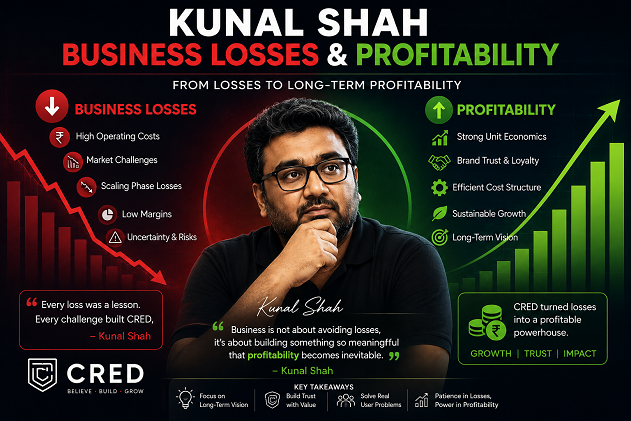
Kunal Shah business losses profitability is best understood through the financial journey of CRED, the fintech company founded by Kunal Shah in 2018. CRED has remained loss-making on a net basis, but its financial performance has changed significantly as revenue has grown, product adoption has increased, and operating losses have narrowed. In FY25, CRED reported operating revenue of ₹2,735 crore, up 16% year over year, while operating losses fell 51% to ₹298 crore. Total losses were ₹1,457 crore.
The story is therefore not simply about “losses.” It is about how a venture-backed fintech moves from aggressive customer acquisition and product development toward monetisation, operating leverage, and eventual profitability.
Introduction to Kunal Shah’s Business Journey
Kunal Shah is one of India’s best-known technology entrepreneurs, particularly because of his work in digital payments and fintech. His entrepreneurial journey includes FreeCharge, followed by CRED, which he founded in 2018. CRED initially focused on helping users pay credit-card bills while building an ecosystem around financially responsible consumers. Over time, the company expanded into a broader collection of financial products and services.
The financial story surrounding Kunal Shah is particularly interesting because it challenges the conventional idea that a successful startup must immediately generate accounting profits. CRED spent years investing in product development, customer acquisition, technology, financial services, and ecosystem expansion. Consequently, the company reported substantial losses during its growth period.
However, those losses need to be examined alongside revenue growth and operating performance.
In FY24, CRED’s operating revenue increased 66% to ₹2,473 crore, while operating losses declined 41% to ₹609 crore from ₹1,024 crore in FY23.
By FY25, the improvement continued. Revenue reached ₹2,735 crore, while operating losses declined to ₹298 crore.
CRED’s recent financial progression
| Financial year | Operating revenue | Operating loss | Key observation |
|---|---|---|---|
| FY23 | ₹1,484.6 crore | ₹1,024 crore | High-growth investment phase |
| FY24 | ₹2,473 crore | ₹609 crore | Strong revenue growth and lower losses |
| FY25 | ₹2,735 crore | ₹298 crore | Major operating-loss reduction |
This progression provides an important lesson about startup economics. Revenue growth alone does not guarantee profitability. At the same time, losses alone do not necessarily mean that a business model is failing.
The more useful question is whether the company is moving toward better unit economics and operating leverage.
CRED’s recent results suggest that it has made meaningful progress in that direction, although it remained loss-making on a total/net basis in FY25.
Understanding Why CRED Initially Reported Large Losses
To understand Kunal Shah’s business losses, it is necessary to understand the economics of a technology startup.
When CRED was developing its market position, significant amounts of money were required for technology, employees, marketing, customer acquisition, infrastructure, product development, and expansion into new financial services.
A young fintech company cannot simply launch an application and immediately become profitable. It needs to attract users, establish trust, develop financial partnerships, create products, build technology infrastructure, and comply with financial regulations.
CRED’s initial proposition was also deliberately selective. It focused on affluent and creditworthy consumers rather than trying to acquire every possible customer.
This strategy created a different economic opportunity. A smaller number of high-value customers could potentially generate greater revenue than a massive base of low-value users.
The company therefore spent years building a premium consumer-finance ecosystem.
Major categories of startup expenses
| Expense category | Why it matters |
|---|---|
| Employee costs | Product, engineering, sales and management |
| Marketing | Building awareness and customer acquisition |
| Technology | Apps, infrastructure, AI and security |
| Product development | Launching additional financial services |
| Compliance | Meeting financial-sector requirements |
| Customer incentives | Encouraging initial adoption |
| Operations | Supporting a growing customer base |
| ESOP costs | Employee compensation-related accounting expenses |
CRED’s losses also need to be separated into operating losses and total losses. This distinction is important.
In FY25, the company’s operating loss was ₹298 crore, while total loss was ₹1,457 crore. The difference reflects items beyond the core operating result, including expenses such as employee stock-option costs and depreciation.
Therefore, saying simply that “CRED lost ₹1,457 crore” does not fully explain its operating performance.
A better analysis asks:
How quickly is revenue growing?
How quickly are operating losses declining?
Are users becoming more valuable?
Is the company reducing customer-acquisition costs?
Are multiple products generating revenue from the same customer?
Those questions provide a much clearer picture of the business.
CRED’s Revenue Growth and the Shift Toward Monetisation
One of the strongest indicators in Kunal Shah’s business story is the change in CRED’s revenue.
CRED’s operating revenue grew from ₹1,484.6 crore in FY23 to ₹2,473 crore in FY24, representing approximately 66% growth. In FY25, revenue increased further to ₹2,735 crore.
This demonstrates that CRED has moved beyond being primarily a credit-card bill payment application.
The company’s strategy increasingly involves monetising customers through multiple financial products.
CRED reported that approximately 45% of active members used three or more products during FY25. Customers using four or more products generated 75% higher average revenue per user than the platform average.
That is an important business-development strategy.
Instead of repeatedly acquiring new customers, a company can increase revenue by selling additional services to existing customers.
CRED’s monetisation model
| Product/service area | Potential revenue opportunity |
|---|---|
| Payments | Transaction-related monetisation |
| Lending | Financial-service revenue |
| Insurance | Distribution and commissions |
| Credit information | Financial-product engagement |
| Card management | Customer retention |
| CRED Money | Financial services |
| CRED Cash+ | Loan-against-securities offering |
| Advertising/brand partnerships | Consumer-finance audience monetisation |
This approach can potentially improve unit economics.
Suppose a company spends ₹1,000 to acquire a customer. If that customer generates only ₹500 of lifetime revenue, the business is structurally weak.
But if the same customer uses several products and generates ₹2,000 or ₹3,000 of lifetime revenue, the original acquisition cost becomes much more attractive.
That appears to be one of the principles behind CRED’s strategy.
Kunal Shah has also highlighted revenue, profitability, and growth as more meaningful indicators than simply focusing on valuation. Forbes India reported his emphasis on those operating measures while discussing CRED’s financial progress.
This represents a significant change from the earlier startup-growth mentality.
FY24: The Turning Point in CRED’s Financial Performance
FY24 was an important year in CRED’s financial development.
The company reported operating revenue of ₹2,473 crore, compared with ₹1,484.6 crore in FY23. At the same time, operating losses declined from ₹1,024 crore to ₹609 crore.
This combination is much more meaningful than revenue growth alone.
A company can grow revenue while losing more money. In that situation, growth may actually increase financial risk.
CRED’s FY24 numbers showed the opposite direction:
Revenue increased substantially while operating losses decreased.
That indicates improving operating leverage.
FY23 versus FY24
| Metric | FY23 | FY24 | Direction |
|---|---|---|---|
| Operating revenue | ₹1,484.6 crore | ₹2,473 crore | Strong increase |
| Operating loss | ₹1,024 crore | ₹609 crore | Significant reduction |
| Revenue growth | — | 66% | Positive |
| Loss reduction | — | 41% | Positive |
| Customer acquisition cost | Higher | Reduced | Improved |
CRED attributed the improvement to several factors, including increased monetised members, lower customer-acquisition costs, deeper customer relationships, and successful product launches.
This is important because customer-acquisition cost is one of the most critical measurements for digital businesses.
A startup that constantly pays large sums to acquire every new customer can struggle to achieve sustainable profitability.
Organic growth and referrals can change that equation.
If existing customers recommend the service to new users, the company can grow without spending the same amount on advertising.
This is particularly valuable for a financial platform because customer trust and reputation can produce strong referral effects.
The FY24 performance therefore represented more than a simple improvement in accounting numbers. It suggested that CRED’s underlying business model was becoming more efficient.
FY25: Losses Narrow Further While Revenue Continues Growing
FY25 provided even stronger evidence of operational improvement.
CRED reported ₹2,735 crore in operating revenue, representing a 16% increase from FY24. More importantly, operating losses declined from ₹609 crore to ₹298 crore—a reduction of approximately 51%.
Total losses declined 11.5% to ₹1,457 crore.
The difference between operating losses and total losses is important. It demonstrates why financial analysis should not rely on one number.
FY25 financial snapshot
| Metric | FY25 result |
|---|---|
| Operating revenue | ₹2,735 crore |
| Revenue growth | 16% |
| Operating loss | ₹298 crore |
| Operating-loss reduction | 51% |
| Total loss | ₹1,457 crore |
| Gross margin | Approximately 70% |
| Monthly transacting users | 1.26 crore |
| Payment value processed | ₹8.5 lakh crore |
| Managed lending AUM | ₹22,000 crore |
CRED also reported a gross margin of approximately 70%, suggesting that the company has a relatively strong gross-level economics structure even though it remained loss-making overall.
The company reported that monthly transacting users increased 14.5% to 1.26 crore, while transactions per user increased 34% to 14.4 per month. Total payment value processed increased 23% to ₹8.5 lakh crore.
These figures are particularly significant because they demonstrate increasing engagement.
A profitable fintech requires more than users—it requires users who transact, borrow, purchase financial products, and interact with monetisable services.
CRED’s FY25 results therefore suggest that its strategy is shifting toward deeper monetisation rather than pure user acquisition.
Business Model: Why CRED Could Become Profitable
CRED’s potential profitability depends on the relationship between customer value and operating costs.
Its business model has expanded considerably from its original credit-card bill payment proposition.
The company now operates across payments, lending, insurance, credit-related products, card management, and other financial services.
This creates multiple revenue opportunities from the same user.
For example, one customer might:
- Pay a credit-card bill.
- Use a CRED payment product.
- Obtain a credit-related service.
- Use an insurance product.
- Borrow through a lending product.
- Use another financial-management feature.
Each interaction can potentially create revenue.
The multi-product economics
| Customer behaviour | Business benefit |
|---|---|
| One product | Basic monetisation |
| Two products | Higher engagement |
| Three products | Stronger retention |
| Four+ products | Higher potential ARPU |
| Frequent transactions | More monetisation opportunities |
| Long-term membership | Higher customer lifetime value |
CRED reported that customers using four or more products generated 75% higher ARPU than its average.
This is a powerful model because it can reduce dependence on continuous customer acquisition.
Another important area is lending.
CRED’s managed lending assets under management reached ₹22,000 crore in FY25, making lending one of its major business segments.
However, lending also introduces additional risks.
Credit businesses must manage defaults, regulatory requirements, underwriting quality, partner relationships, and risk-adjusted returns.
Therefore, lending can increase revenue while simultaneously increasing financial and operational complexity.
CRED’s premium customer positioning may provide an advantage because the company focuses heavily on users with stronger credit profiles, but no lending business is completely free of risk.
Ultimately, profitability will depend on whether revenue from payments, lending, insurance, and other services grows faster than employee, technology, marketing, compliance, and financial-service costs.
Kunal Shah’s Strategy: From Growth at Any Cost to Sustainable Economics
Kunal Shah’s business philosophy is particularly relevant to the discussion of CRED’s losses.
The startup ecosystem often rewards rapid user growth, valuation increases, and market expansion. But once capital becomes more expensive and investors demand stronger financial discipline, companies have to demonstrate a path toward sustainable economics.
CRED’s financial evolution reflects this transition.
In FY24, the company reduced customer-acquisition costs by 40%, according to Forbes India, while revenue grew strongly.
This is strategically important.
A company can improve profitability in two broad ways:
Increase revenue per customer.
Reduce the cost of serving and acquiring customers.
CRED has been working on both.
Strategic profitability levers
| Profitability lever | CRED’s direction |
|---|---|
| Revenue growth | Increasing |
| Product adoption | Increasing |
| Customer acquisition cost | Reduced |
| User engagement | Increasing |
| ARPU | Strengthening |
| Gross margin | Approximately 70% in FY25 |
| Operating losses | Falling |
| Product diversification | Increasing |
This strategy also demonstrates why startup profitability can take years.
A fintech platform needs scale before certain fixed technology and corporate costs become efficient.
Once millions of users are using the platform, additional transactions can potentially be handled at a lower incremental cost than acquiring and servicing the first customers.
This is known as operating leverage.
The key question is whether CRED can maintain revenue growth while keeping expense growth slower.
FY25 offered encouraging evidence because revenue rose 16%, while operating losses fell by more than half.
That is precisely the pattern investors usually want to see from a late-stage startup moving toward profitability.
Why CRED Is Still Loss-Making Despite Strong Progress
It would be misleading to describe CRED as a profitable company simply because operating losses have declined.
The company remained loss-making in FY25, with total losses of ₹1,457 crore.
This distinction matters.
A business can have improving operating economics while still reporting substantial total losses due to non-operating costs and accounting expenses.
CRED’s reported total loss includes items such as ESOP costs and depreciation, according to recent reporting.
Operating profit versus total profit
| Measure | Meaning |
|---|---|
| Revenue | Money generated from business operations |
| Gross profit | Revenue after direct costs |
| Operating profit | Profit after operating expenses |
| Operating loss | Operating expenses exceed operating income |
| Net/total profit | Result after additional expenses and income |
| Net/total loss | Overall financial loss |
Therefore, the statement “CRED is losing money” is technically correct at the total-profit level.
But the more nuanced statement is:
CRED has substantially improved its operating economics while remaining unprofitable on a total basis.
That distinction is crucial when evaluating Kunal Shah’s business performance.
The company has also stated that it is targeting full profitability in FY26, according to 2026 reporting.
Whether that goal is achieved will depend on several factors, including revenue growth, lending economics, employee costs, marketing expenses, financial-market conditions, and the company’s ability to scale newer products.
The path is therefore promising but not guaranteed.
A company should be judged on actual audited results rather than future promises.
CRED’s Biggest Risks on the Road to Profitability
CRED’s progress is encouraging, but several risks could slow its journey toward profitability.
The first is competition.
Fintech is highly competitive, with banks, payment companies, digital wallets, lending platforms, credit-card companies, and financial marketplaces competing for customers.
The second risk is regulation.
Financial services operate under strict regulatory frameworks. Changes in lending rules, data protection, payment regulations, or consumer-protection requirements can affect business models.
The third risk is credit quality.
CRED’s expansion into lending creates additional opportunities but also exposes the business to credit and financial risk.
The fourth is valuation pressure.
CRED became a unicorn in 2021 after a $215 million Series D round valued it at $2.2 billion and later reached a reported peak valuation of $6.4 billion.
However, high private-market valuations do not automatically represent profitability.
Major profitability risks
| Risk | Possible effect |
|---|---|
| Competition | Lower margins |
| Regulatory changes | Higher compliance costs |
| Credit defaults | Lending losses |
| Rising employee costs | Higher operating expenses |
| Slower revenue growth | Delayed profitability |
| Funding conditions | Reduced financial flexibility |
| Product complexity | Higher operational costs |
| Customer retention | Higher acquisition expenses |
The funding environment is also important.
Startups that previously relied on abundant venture capital may need to become more financially disciplined when investors become cautious.
This is why CRED’s reduction in operating losses is significant.
A business that can survive and grow without continuously increasing its burn rate is structurally stronger.
Kunal Shah’s own comments suggest that revenue, growth, and profitability matter more than valuation alone.
That philosophy is increasingly relevant in the mature phase of the Indian startup ecosystem.
Final Verdict: Is Kunal Shah’s Business Becoming Profitable?
The answer requires nuance.
CRED is not yet a fully profitable business based on its FY25 total-loss figure, but its operating economics have improved substantially.
The strongest evidence is the combination of rising revenue and sharply declining operating losses.
Between FY23 and FY25, operating revenue increased from ₹1,484.6 crore to ₹2,735 crore, while operating losses fell from ₹1,024 crore to ₹298 crore.
Overall assessment
| Area | Assessment |
|---|---|
| Revenue growth | Strong |
| Operating-loss reduction | Very strong |
| User engagement | Improving |
| Product diversification | Strong |
| Gross margin | Strong |
| Customer monetisation | Improving |
| Total profitability | Not yet achieved in FY25 |
| Long-term potential | Significant |
| Main challenge | Converting operating improvement into sustained net profitability |
The most interesting aspect of Kunal Shah’s business story is therefore not the headline loss figure.
It is the direction of travel.
A startup that loses money while its revenue stagnates is concerning. A startup that grows revenue while simultaneously cutting operating losses is a very different situation.
CRED’s FY25 performance suggests that it has moved considerably closer to sustainable operating economics.
The company’s monthly transacting users increased to 1.26 crore, payment value reached ₹8.5 lakh crore, and managed lending assets reached ₹22,000 crore.
These figures demonstrate meaningful scale.
The next major milestone is profitability.
If CRED can continue increasing product adoption, improve customer lifetime value, control acquisition costs, manage lending risks, and maintain healthy gross margins, it has a credible path toward becoming profitable.
But the distinction between operating improvement and actual net profitability should remain clear.
Conclusion
Kunal Shah’s business journey illustrates the changing nature of modern startup economics. CRED spent years prioritising product development, customer acquisition, technology, and market expansion. Those investments produced significant losses, but they also created a large and highly engaged financial-services platform.
By FY25, the company had demonstrated substantial progress: revenue reached ₹2,735 crore, operating losses fell to ₹298 crore, and gross margins were approximately 70%.
Yet total losses remained ₹1,457 crore, meaning the profitability journey was not complete.
Therefore, the fairest conclusion is that Kunal Shah’s CRED has moved from a high-burn growth story toward a more disciplined monetisation and profitability story.
Its future success will depend less on headline valuation and more on whether it can convert its strong customer engagement and expanding financial ecosystem into consistent, sustainable profits.
That makes CRED’s financial journey one of the more interesting case studies in India’s fintech industry—and a useful example of how a startup can gradually transform losses into a potential path toward profitability.