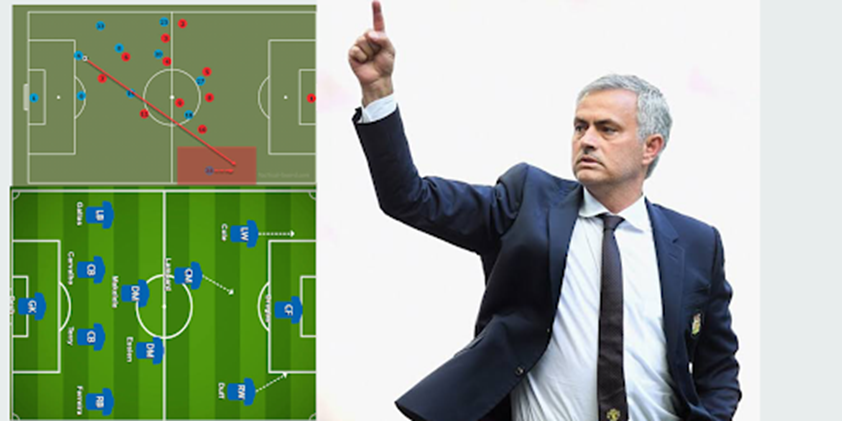
José Mourinho’s tactical philosophy has evolved across Porto, Chelsea, Inter Milan, Real Madrid and his other clubs, but several principles have remained remarkably consistent. The 1xBet download app is definitely the best software you can get for your mobile devices in order to bet on the squads that have been coached by Mourinho.
Rather than committing to one rigid formation, Mourinho generally adapts his structure to the qualities of his players and the threats posed by the opponent. His teams are often defined less by possession and more by 3 other elements:
- control of space;
- defensive organisation;
- and the exploitation of transitions.
One central principle is the compact defensive block. Mourinho’s teams frequently defend with short distances between the defensive and midfield lines, protecting central areas and forcing opponents towards less dangerous zones. At Tottenham, for example, wide players could move inside to protect the central channels while the midfield pivot shifted across when necessary. The objective was not simply to chase the ball, but to restrict the opponent’s access to dangerous spaces. And remember that if you download the 1xBet app, you can also bet on Tottenham’s matches too.
A 2nd principle is transition football. Once possession is recovered, Mourinho’s teams often try to attack before the opponent can reorganise. This requires players capable of carrying the ball quickly, attacking space and providing immediate forward options. His successful Porto and Real Madrid sides demonstrated how defensive organisation could become the starting point for rapid counter-attacks.
Preparing the matches
Mourinho also places considerable importance on tactical preparation. He has explained that his training work focused on questions such as when and how to press, transitions, possession and positional play. This reflects his broader concept that training should reproduce the tactical situations players encounter during matches.
His preferred formations have changed according to circumstances. Chelsea’s 2004-05 side frequently used a 4-3-3, while later teams commonly defended from 4-2-3-1 structures with a conservative double pivot. This illustrates an important feature of Mourinho’s approach: the formation is a tool, not the philosophy itself.
Finally, game management is fundamental. Mourinho’s teams have often adjusted their defensive height, pressing intensity and attacking risk according to the score and match situation. His tactical model therefore combines 4 elements: preparation, defensive structure, rapid transitions and situational adaptation.