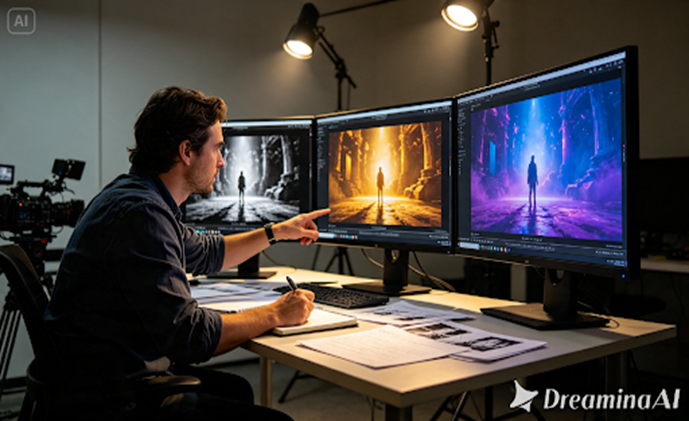
An artist has a concept that exists fully formed in their imagination — a visual idea, an emotional atmosphere, a specific interplay of light and movement that feels complete and powerful in their mind. Communicating that concept to collaborators or realizing it in finished form used to require either extensive storyboarding and pre-visualization or trusting that a production team would understand and execute the vision during filming.
Advanced text to video generation transforms this process, allowing creative concepts to move directly from imagination into generated footage that serves as both a communication tool and a foundation for further development.
Dreamina’s Seedance 2.5 model was built specifically to understand how to translate abstract creative concepts into coherent cinematic sequences, capturing the artistic vision that exists only as idea and making it visible as finished footage.
Why creative concepts need visual translation
A creative concept is fundamentally different from a plot or a narrative. A plot describes what happens. A concept describes how something feels, looks, and communicates aesthetically and emotionally. A photographer might have a concept about using negative space to communicate loneliness. A filmmaker might conceive of a sequence built entirely around a specific color palette. A designer might imagine how movement through space would feel with a particular visual approach. These concepts don’t translate easily into words because their essence is visual and experiential.
Traditional production requires translating these visual concepts into storyboards, shot lists, and detailed direction before production can even begin. That translation step happens through conversation and iteration, with each person involved potentially interpreting the original concept slightly differently. Visualization through text to video allows the original concept to be rendered directly, giving everyone involved an actual reference of what the artist originally envisioned.
Translating atmosphere into visual language
The most powerful creative concepts are often atmospheric. An artist imagines how something feels — the quality of light, the rhythm of movement, the emotional texture of a space. Translating atmosphere into visual language requires describing sensory experience in terms that a generation model can interpret. Rather than saying “this should feel mysterious,” describe what creates mystery visually — darkness, selective illumination, limited depth of field, compositional choices that obscure rather than reveal.
This precision is actually closer to how artists naturally think than vague emotional direction. An artist imagining a sequence already knows what creates mystery visually, they just need to articulate those specific choices clearly enough for them to be executed.
What makes Seedance 2.5 built for creative concept translation
Seedance 2.5 was designed to render abstract creative concepts with the visual sophistication and aesthetic intentionality that makes generated footage a legitimate creative tool rather than just a technical demonstration.
Visual coherence across artistic choices
The model understands how different visual elements — color, light, composition, movement — work together to communicate artistic intent. Rather than random aesthetic choices, generated footage reflects a unified creative vision where every element reinforces the conceptual foundation. Cinematic language becomes visible in how these elements work together.
Aesthetic intentionality in frame composition
Each frame can be rendered with intentional compositional choices that reflect creative concept. Whether emphasizing negative space, layering visual depth, using geometric patterns, or creating visual asymmetry, the model executes compositional choices that communicate artistic vision through frame design.
Color as a creative communication tool
The model renders color with sophistication, understanding how specific palettes create emotional resonance and communicate thematic content. A monochromatic palette creates different feeling than vibrant saturation. Warm versus cool tones communicate fundamentally different moods. Color consistency reinforces conceptual unity.
Light behavior that reveals artistic thinking
Different lighting approaches communicate different creative visions. Hard-edged light creates drama and clarity. Diffuse light creates softness and ambiguity. Specific color temperatures communicate era or emotion. Seedance 2.5 renders light as a creative tool, not just illumination, allowing artistic concepts about how light should feel to be executed precisely.
Movement that embodies creative vision
Motion transfer consistency has improved to over 90%, which matters for concepts where how something moves communicates artistic intent. Slow, deliberate movement communicates different feeling than quick, restless movement. The model can render movement that embodies creative concepts about pacing, rhythm, and physical expression.
Extended duration for conceptual development
Single-clip generation extends to 30 seconds, with Ultra-long Video Generation mode reaching 180 seconds. Cinematic concepts often require duration to develop fully. An idea about building atmosphere needs time. A concept about progression from one emotional state to another needs runway. Extended duration allows conceptual ideas to unfold and reveal their full complexity.
From artistic concept to cinematic reality
Step 1: Describe your creative concept through sensory language
Visit Dreamina, sign in, and head to the “AI Video” section. Articulate your creative concept as a sensory and visual experience rather than as plot or narrative. Click “Add reference image” if you have mood boards, concept art, or visual references. Write a prompt that captures the atmospheric and aesthetic essence of your concept.
A prompt might read: A sequence where space feels compressed and intimate despite vast scale, light comes from unexpected directions creating geometric patterns, movement is deliberate and almost ritualistic, color palette emphasizes cool tones with occasional warm accents that feel significant, the overall mood is contemplative and formally composed.
Step 2: Generate with Seedance 2.5 to realize the vision
Select the Seedance 2.5 model. Choose 30-60 seconds depending on how much time your concept needs to develop. Pick 16:9 for cinematic contexts or 9:16 for social platforms. Click Dreamina’s generation icon and watch your creative concept become visible footage.
Step 3: Evaluate the concept’s translation, then refine
Use Dreamina’s AI editing tools sparingly to enhance conceptual elements. Upscale sharpens compositional details that embody your vision, while Generate Soundtrack adds audio that reinforces the atmospheric concept. Review the generated footage against your original concept — does it feel true to your artistic intent? Does it communicate what you imagined? If refinements would strengthen the concept, adjust and regenerate specific moments rather than starting over.
Articulating concepts clearly enough to be visible
The key to translating creative concepts effectively is articulating them with enough specificity that they’re actionable while remaining true to the artist’s original vision. A prompt can’t be so vague that it allows infinite interpretation, but it also can’t be so prescriptive that it loses the conceptual freedom that makes artistic vision distinctive.
When concepts become collaboratively visible
The most powerful aspect of visualization is how it enables collaboration. An artistic concept that exists only in one person’s imagination becomes something a team can see, discuss, build upon, and refine together.
With Dreamina and its Seedance 2.5 model, creative concepts can move directly from an artist’s imagination into cinematic sequences that capture artistic vision, making the invisible visible and transforming solitary imagination into something collaborators can actually see and work with.